The work nobody should be doing
We start with a question, not a product: what repetitive work is eating your team's day? Then we build AI to handle that specific thing and own it end to end.
The work still gets done. Nobody on your payroll does it, and you grow without adding headcount to serve the growth.
Growth creates admin. Admin caps growth.
Every local business hits the same wall. The marketing starts working, the calls go up, and suddenly the team cannot keep up with the paperwork the new work generates. So you hire, and margin goes with it.
The instinct is to buy software. But most owners already have five tools that do not talk to each other, and the gaps between them are exactly where the hours go: rekeying the same customer into two systems, chasing a signature, assembling a report by hand every Friday.
We do not arrive with a product to sell you. We arrive with a survey and a stopwatch. Which tasks repeat, how long do they take, how often do they get dropped, and what does dropping one cost.
Then we build for the top of that list and we own it. Not a recommendation deck, not a tool licence and good luck. Something that runs, that we maintain, and that you can point at a number.
Your week, before and after
Same five days, same team, same volume of customers. The only thing that changed is who does the repetitive part.
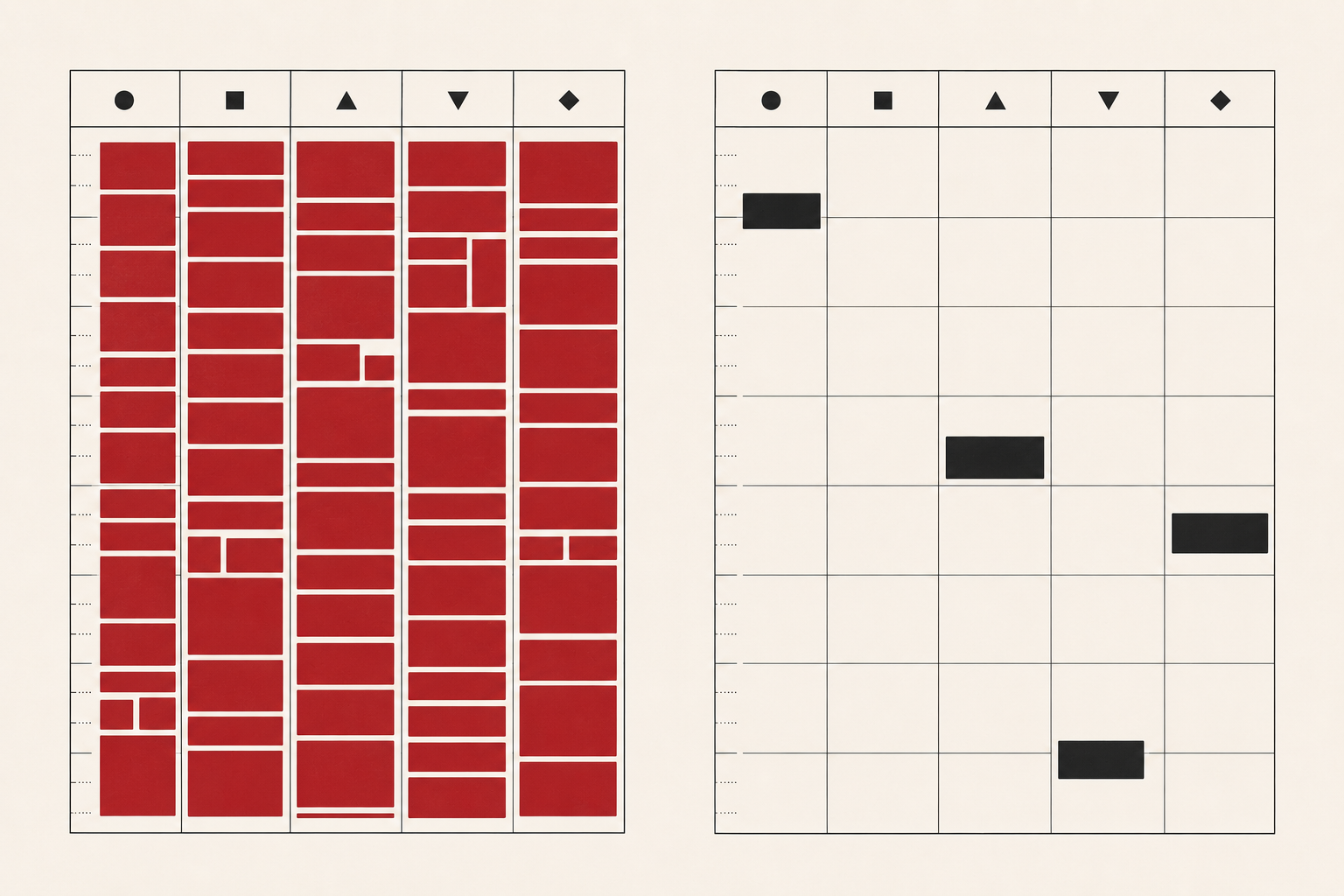
Follow-up, scheduling, intake, quoting, chasing invoices, filing paperwork, assembling the weekly numbers by hand.
The decisions that actually need a person. Everything else still happens, on time, without anyone touching it.
Diagnose, build, adopt, measure.
Four stages, in order. Skipping the first is why most AI projects end up as an expensive tool nobody opens.
Find the work worth removing before proposing anything to build.
One thing at a time, in production, owned by us.
The best build fails if the front desk quietly works around it.
Hours back, revenue recovered, or it did not work.
Diagnose
We survey the people actually doing the work, not just the owner, because owners consistently underestimate where the hours go.
- /Staff survey and interviews across every role
- /Task inventory with frequency and time per task
- /Cost of each dropped or delayed task, in dollars
- /System audit of what you already pay for
- /A shortlist ranked by hours saved against build effort
- /A written plan you can execute with us or without us
Build
We start with the highest-value task and get it live before touching the next. Small, working, and measured beats a grand transformation that never ships.
- /Built into the tools you already use where possible
- /Integrated with your CRM, phone system, and calendar
- /Human handoff designed in for anything sensitive
- /Tested against real cases before it touches a customer
- /A fallback path for every failure mode
- /We maintain it. It is not handed over as your problem.
Adopt
Anything that changes how a team works needs the team on side. This is the stage most implementations skip and most implementations die at.
- /Training built for the people doing the work
- /Written SOPs for the new workflow
- /A named owner on your side for each system
- /A two-week supervised period before it runs unattended
- /A channel for staff to flag what is not working
- /Adjustment based on what they tell us
Measure
We baseline before we build so the improvement is arguable rather than anecdotal.
- /Baseline captured before anything is switched on
- /Hours saved per week, tracked per workflow
- /Revenue recovered from work that used to be dropped
- /Response time before and after, where relevant
- /Monthly review with the numbers in front of you
- /Turned off if it is not earning its keep
Scoped on the first call, before either party agrees to anything.
We tell you what we would build, roughly what it would take, and which of your problems is not worth solving with AI. Some of the most useful outcomes of these calls have been telling an owner to fix a process rather than automate it.
Why work with us
Diagnostic, not a product
We do not have one thing to sell you. What we build depends entirely on what is eating your week.
We own the outcome
Not a strategy deck and an invoice. We build it, we maintain it, and we report on whether it worked.
Built for small teams
Enterprise AI consultancies are not designed for a business with nine people. The economics and the workflow are different, and so is our approach.
It pairs with the demand side
We are also the ones bringing you the extra customers. Automating the work they create is the same conversation, not a second vendor.
Frequently asked
Is this just a chatbot?
Rarely. A chatbot is one possible answer to one possible problem. Most of what we build runs in the background on scheduling, follow-up, paperwork, and data movement, and never talks to a customer at all.
Will it replace my staff?
It replaces tasks, not people. The point is that your existing team can absorb more work without drowning, so growth does not require another salary.
What if it says something wrong to a customer?
Anything customer-facing gets tested against real cases, given a human handoff path, and supervised for two weeks before it runs unattended. Sensitive categories stay under human review.
Do we need new software?
Usually not much. We build into what you already pay for wherever possible. Adding a sixth tool to five that do not talk is not a solution.
How long does it take?
The diagnostic is about two weeks. A first build is typically live within four to six weeks after that, depending on the systems involved.
What if it does not work?
We baseline before we build, so we will know. If a workflow is not earning its keep we turn it off and say so.
Tell us what is eating the day.
Thirty minutes. You describe the tasks that repeat, we tell you what we would build and what it would take. You leave with a plan either way.
Book a callThe repetitive work costing your team the most hours, ranked.
The first thing worth automating and why it is first.
An honest scope in plain terms, before either party agrees to anything.
Hours back and revenue recovered, estimated from your own numbers.